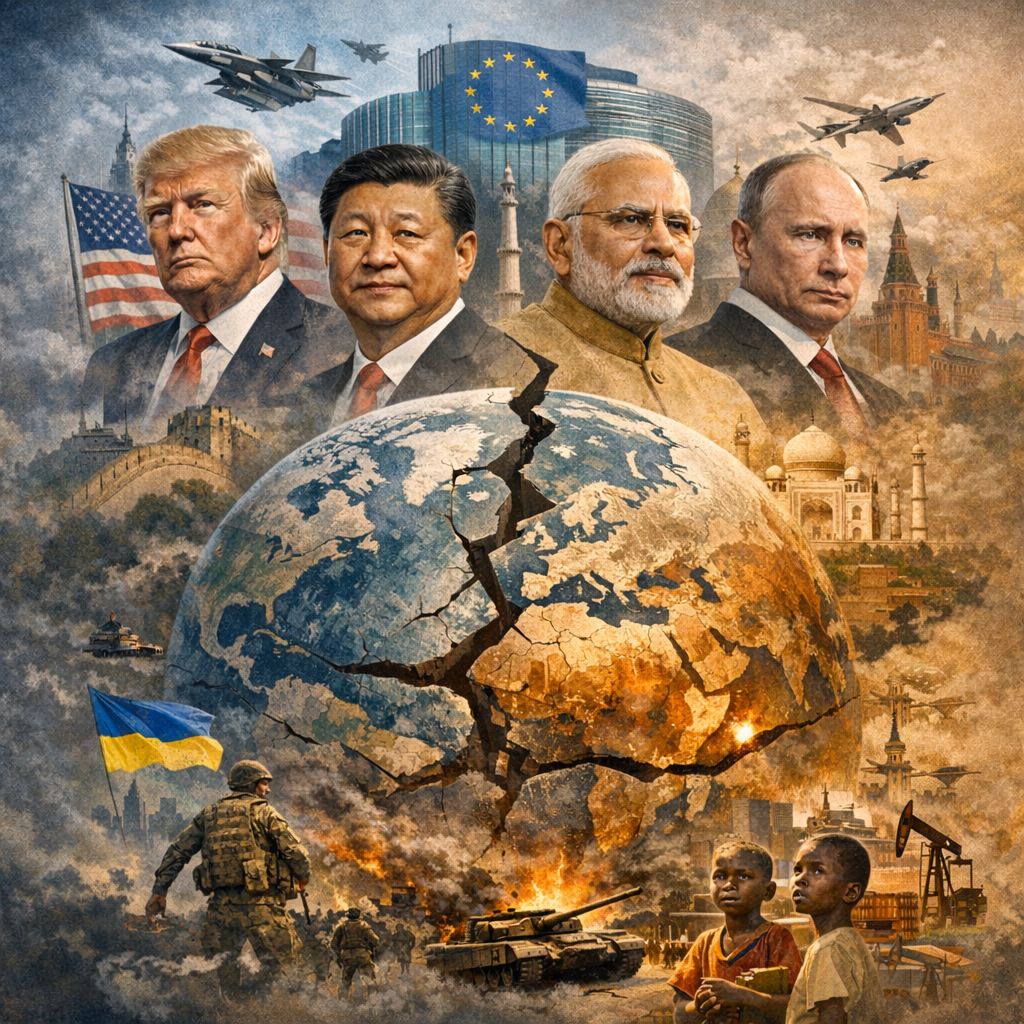
The sense that the world is descending into chaos is widespread. Wars, political polarization, economic instability and environmental crises appear to converge into a single narrative of decline. Yet history suggests that such moments are rarely pure disorder. More often, they mark the slow and uneven transition from one dominant order to another. What we are witnessing today may not be chaos, but the visible strain of an international system that no longer corresponds to the realities of power, technology and human interdependence.
After the Second World War, a relatively stable international framework emerged under Western leadership. Institutions such as the United Nations, the Bretton Woods system, NATO and later the European Union were designed to prevent a return to large-scale conflict and economic collapse. During the Cold War, this order was structured by bipolarity, with the United States and the Soviet Union balancing one another. After 1991, the collapse of the Soviet Union produced a brief unipolar moment in which American economic, military and cultural influence seemed unrivaled. That moment shaped globalization, free trade and liberal democracy as presumed endpoints of history.
History, however, rarely ends. The early twentieth century offers a useful parallel. The decline of the British Empire did not immediately produce a stable successor order. Instead, the world experienced decades of turbulence, including the First World War, the Great Depression and the rise of authoritarian regimes, before a new equilibrium emerged after 1945. Similarly, the fall of the Roman Empire did not lead to instant anarchy, but to a long period of fragmentation and reorganization in which new political, religious and economic structures slowly took shape. These examples remind us that transition periods can last generations.
In the present day, the United States remains a powerful actor, but its role has changed. Political figures such as Donald Trump symbolize a broader inward turn in American politics. His challenge to multilateral agreements, skepticism toward NATO and emphasis on national sovereignty over global responsibility have had lasting effects, even beyond his presidency. Similar tendencies can be seen in other countries, where leaders prioritize domestic legitimacy over international consensus. This does not remove the United States from the global stage, but it alters the expectations others have of its leadership.
China represents another central force in the emerging order. Through initiatives such as the Belt and Road, China has extended its economic and infrastructural influence across Asia, Africa and parts of Europe. Its model of state-led capitalism offers an alternative to Western liberalism, appealing to governments seeking development without political conditionality. Historical parallels can be drawn with the rise of the United States at the end of the nineteenth century, when industrial growth and overseas investment gradually shifted the center of global economic power away from Europe.
Europe, meanwhile, finds itself in an ambiguous position. The European Union remains a major economic bloc, yet struggles with internal divisions, demographic challenges and questions of strategic autonomy. The war in Ukraine has forced Europe to reconsider its dependence on external energy sources and its reliance on American security guarantees. In response, new partnerships have gained importance, particularly with India, which is emerging as a key player in a multipolar world. This echoes earlier periods when European powers sought new alliances to compensate for declining influence, such as during the late nineteenth century balance-of-power politics.
The conflict between Ukraine and Russia is often framed as a return of old-style geopolitics, but it also reflects deeper systemic tensions. Russia’s actions challenge the post-Cold War assumption that borders in Europe were settled. At the same time, the global response has revealed fractures in international solidarity. Many countries in the Global South view the conflict through the lens of their own historical experiences with colonialism, intervention and selective enforcement of international norms. This divergence recalls the Non-Aligned Movement during the Cold War, when states sought to navigate between competing power blocs without fully committing to either.
Africa’s role in the current transition deserves particular attention. Once primarily shaped by colonial borders and Cold War proxy politics, the continent is now central to debates on resources, demographics and climate resilience. Countries such as Nigeria, Ethiopia and Kenya are becoming regional anchors, while external actors compete for influence through investment, military cooperation and technology transfer. This situation resembles the nineteenth-century scramble for Africa in form, but not in context. Today, African governments possess greater agency, even if structural inequalities remain.
The Middle East offers another historical and contemporary parallel. The decline of the Ottoman Empire in the early twentieth century led to artificial borders, external mandates and prolonged instability. Today, the region is again in flux. Saudi Arabia’s diversification efforts, Iran’s regional ambitions, the Abraham Accords and the ongoing Israeli-Palestinian conflict all signal a reordering of alliances. The region’s gradual shift away from total dependence on Western security frameworks mirrors earlier moments when regional powers asserted greater autonomy.
Global challenges such as poverty, migration, climate change and technological disruption cut across all these geopolitical shifts. The Industrial Revolution offers a useful historical comparison. It produced unprecedented wealth alongside extreme inequality, social unrest and environmental degradation. Over time, new institutions, labor rights and social safety nets emerged in response. Similarly, today’s digital and ecological transformations are destabilizing existing systems while creating possibilities for new forms of cooperation, governance and economic inclusion.
This raises the central question: are we living in chaos, or in a transitional order that simply lacks a clear narrative? Chaos implies the absence of structure. What we see instead is a proliferation of structures, overlapping, competing and unfinished. Power is no longer concentrated in a single center, but distributed across states, corporations, networks and even individuals. This diffusion makes the system harder to understand and manage, but not necessarily more random.
The opportunity of the present moment lies precisely in this openness. When no single model dominates, alternatives can be tested. New voices can emerge, particularly from regions and groups historically excluded from global decision-making. The risk, however, is that without shared principles, competition hardens into conflict and inequality deepens.
History shows that new world orders are rarely consciously designed. They emerge from the accumulated responses to crisis. The Peace of Westphalia, the Congress of Vienna and the post-1945 institutions all arose from the wreckage of conflict, not from periods of stability. If this pattern holds, the current reordering will be shaped by how societies respond to uncertainty, whether through cooperation, withdrawal or domination.
The present age, then, is neither purely chaotic nor comfortably ordered. It is an in-between time, marked by friction, experimentation and contested meaning. Whether it leads to a more fragmented world or to a more plural and resilient one depends less on inevitability than on collective choices. History does not repeat itself, but it does remind us that disorder is often the visible surface of deeper transformation.