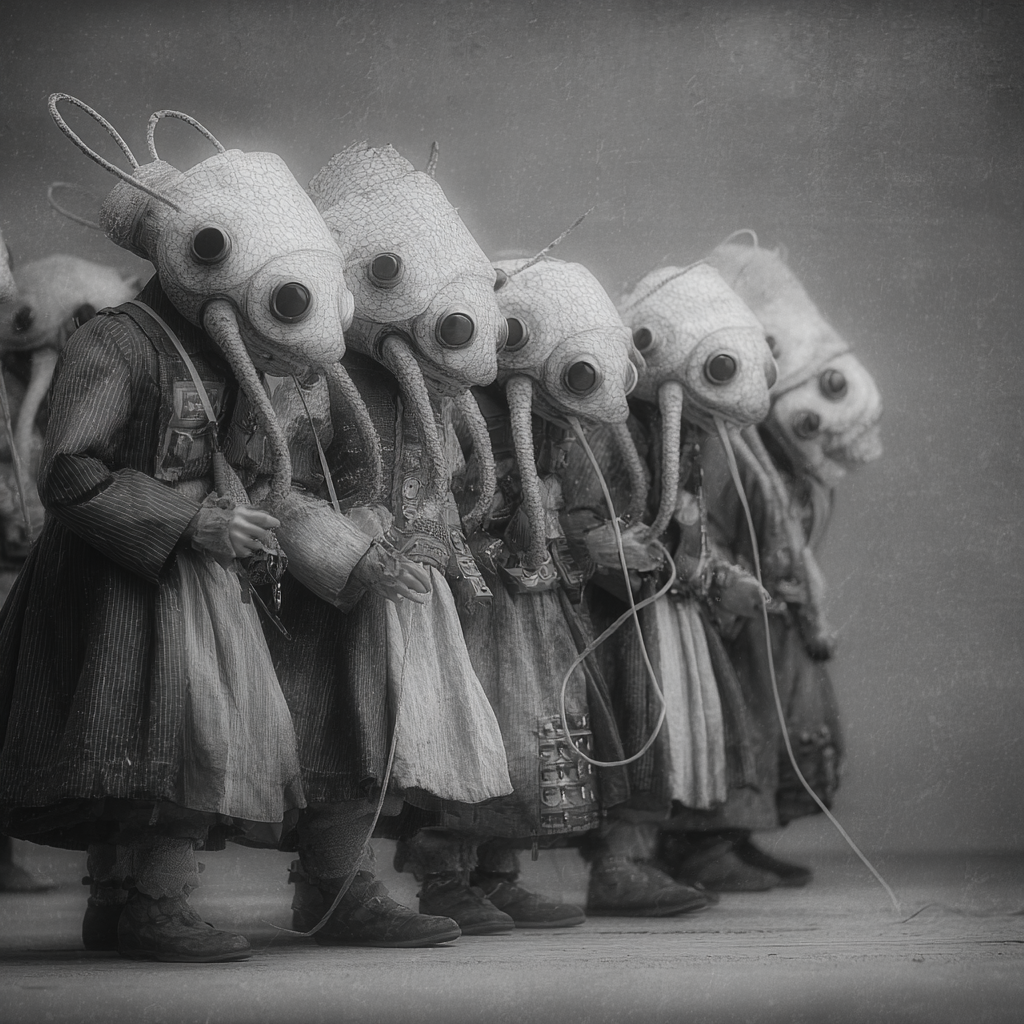
Following a conversation with Marta Lenartowicz, Cadell Last, Weaver D.R. Weinbaum, Iwona Sołtysińska, Martin Ringer and Gys Godderis in 2020
The conversations happened six years ago. That matters. Not as a biographical footnote, but as the condition of the text.
Because what I can say now is not simply the result of what was said then. It is the result of what resisted being said for years afterwards. The dialogue gave me a vocabulary, yes, but it also exposed a fault line: I could suddenly name the self as something constructed, composite, relational, linguistically scaffolded. And yet precisely because I could name it, I felt the danger of naming too quickly.
There is a kind of understanding that arrives fast, and a kind that arrives only when it has outlasted your appetite for neatness.
I hesitated because the concept of the self is not only a topic, it is also the instrument with which I would write about the topic. The “I” that tries to explain the monad is already a performance of monadic grammar. Even the critic of the self is tempted to stand outside the self, to speak as if from a clean vantage point. But there is no clean vantage point. There is only another arrangement of voices, another selection, another loyalty, another concealment.
So the delay was not laziness. It was suspicion toward fluency.
To write quickly would have been to let the most dominant voice in me take the microphone and call it insight. It would have been to smooth the polyphony into a single argument, to turn a living problem into a coherent product. And coherence can be a form of violence when it arrives too early: it seals the question before the question has finished working in the body.
In those six years, the world did what it always does: it did not merely change externally, it changed the internal conditions of thought. More reading, yes, but also more loss, more responsibility, more evidence that the self is not a sovereign unit but a fragile organization of relations. The “self” began to feel less like a concept to debate and more like a practice that either holds or fails under pressure. I became older, more careful, and therefore less eager to conclude.
Only then did the original question return with a different weight: not “is the self a monad or a construct?” but “what does it cost to live as if it were a monad, and what does it cost to stop pretending?”
The initial question came from Marta in 2020, in the space of the School of Thinking, where we were circling around the influence of metacognitive presuppositions, meaning the ways we silently assume thinking works, and how those assumptions determine what we can and cannot think. Marta proposed that if we had to name one presupposition that shapes almost every conceivable train of thought, it might be the concept of the self. The self appears as a cognitively active object, a subject, explicitly or implicitly present in every thought, and whose characteristics steer most other mental operations. From there followed the provocative implication: if we wanted a single mind-changing, worldview-changing, world-changing operation, we should tweak that concept. If the self is the hidden operator behind all cognition, then changing it would change every thought. An instant makeover of reality, oneself included.
The manner the self is structured and maintained has colossal consequences. Part of that structuration is idiosyncratic, the particular history of a particular life. Part of it is biological, the inheritance of an evolving cognising organism. Part of it is socio-cultural, the habits and narratives of a world into which one is born. But there is another force that is so intimate we often miss it: language.
The socio-cultural shaping of the self is easy to notice if you have ever stepped far enough outside your village, literal or symbolic. But language shapes not only what we can say, it shapes what we can easily experience. A table is referred to by a noun, and so am I. Grammar teaches ontology. The world becomes populated by things, and the self becomes the chief thing, the one presumed container in which cognition occurs. Marta’s small sabotage was simple and devastating: imagine humans referring to themselves and others using only verbs and adverbs, while keeping the rest of the lexicon and grammar intact. Not “I” and “you,” but “hesitatingly responding,” “boringly lecturing,” “carefully withdrawing,” “watchfully enduring.” In that linguistic world, the self would be less object and more motion, less possession and more activity. The subject would not vanish, but its solidity would be harder to maintain.
So the self, active and present in nearly every thought, appears as a composite creation. Its structure and attributes are shaped by influences across several scales: biological, socio-cultural, linguistic, psycho-relational. Yet something striking happens. These complex influences can become internally concealed, collapsing into the inner experience described by Cadell Last and Pauline Ezan: the monadic sense of a clearly distinct, unmistakably single holistic unit, cut out from the rest of the universe.
How and why does this happen? Or rather, do we agree that such concealment occurs in the first place? Or is the monad the primary condition of the self?
To speak of concealment is not to accuse the mind of stupidity. It is to point to function. Concealment can be a kind of cognitive mercy. Life is too complex to be lived without compression. The question is not whether we compress, but what our compressions do to us.
The simplest explanation of concealment, to me, still runs through language. Thinking and speech are distinct, but thinking contains speech. There is thinking that is pre-linguistic, a-linguistic, bodily, imagistic. Yet speech is always carried out by thinking. Therefore, much of what we can observe in speech can be treated as a clue to thought. Not the other way around, because thinking exceeds speech, but at least this way: speech can reveal the structure of mind.
So we ask: is speech sourced in a monad? Obviously not, or not in the way the monad likes to imagine.
How did we invent the sounds we make? How did we design the tonal composition that makes an utterance comforting, humiliating, seductive, threatening? How did we decide which aspects of reality deserve words, and which remain unnamed? Our words arrive already inhabited. Each word carries a tail of references, quotations, borrowed authority, echoes of earlier speakers. Speech is full of other voices, present in your mind, which is polyphony. Speech is full of other utterances, other texts, other conversations, which is intertextuality. Bakhtin’s point was not merely literary. It was ontological: language is social through and through, and the individual voice is always threaded with the voices of others.
To test this, consider the sentence: thought is always dialogical. If you are even slightly steeped in certain traditions, it immediately calls up other voices, other books, other conversations. You feel the impulse to answer with them, to align with them, to resist them, to cite them, to rephrase them. Something in you wants to keep in touch with them. It is as if they want you to make them present.
If we can agree, and it is an open question, that speech is polyphonic and intertextual, then it is reasonable to propose that thought is polyphonic and intertextual as well. Thinking carries forms, patterns, voices, clusters, habits, that do not arise from a single holistic unit, but are associated with it, attributed to it, gathered under the label “me.” The relation is not symmetrical. It is not “a self produces thoughts.” It is at least as plausible that thinking, in its multiplicity, fashions and maintains the self, and then presents itself as if sourced from a single point.
The mind is perfectly capable of narrating its own activity as a closed loop, as if all thought originates within one sovereign centre. But this is less a discovery than a performance, and sometimes a form of self-deception, because it conceals the other points and other voices by which the loop is actually sustained. When a mind chooses to expose them, it may discover that much of what it knits together is sourced from outside the self as conceptualised, everything except perhaps one crucial activity: selection.
Selection is not small. It is the gesture that makes a life inhabitable. It is the activity of deciding what to bring up and be loyal to, what to keep in touch with, what to re-present. In that sense, the most self-like feature of the self might not be a monadic core, but the motion of drawing relations.
This, for me, is where the question shifts from metaphysics to ethics.
Because if the self is not a sealed unit but a relational organisation, then the other is not an optional add-on to an already complete subject. The other is already inside the conditions of subjectivity. The voices that compose us are not neutral. They carry demands, invitations, accusations, expectations, gifts. The self is not only shaped by relations, it is in part a record of what it has been loyal to.
And that is why coherence can be dangerous. Coherence can be an achievement, but it can also be a cover. It can turn plurality into ownership, inheritance into identity, relation into possession. It can silence the voices that do not fit the narrative that keeps the self stable.
So what I can say now, from the maturity of delay, is that the “self” is less a thing than an ongoing act of compression. Not a trick, not a mere illusion, but a functional editing of complexity into something inhabitable. A useful concealment, sometimes even a compassionate one: a way of making the unbearable density of relational life feel like a manageable unit.
Yet it is also a concealment with consequences. It can harden into a prison the moment we forget it is an edit. It can convince us that we are authors where we are in fact arrangers. It can make us believe we speak alone where we are in fact conducting a choir.
This is where the metaphors in our title begin to change meaning.
Alienated monads: that is the self when compression becomes isolation, when the editing produces not livability but loneliness, when the unit hardens and the world becomes foreign. Polyphonic orchestras: that is the self when the plurality is acknowledged, when the different voices are heard and held in a workable tension, when the self is understood as a kind of conducting rather than a kind of substance. Yet stranger creatures: that is perhaps what we become when we refuse the comfort of both simplifications, when we accept that we are neither isolated units nor harmonious collectives, but dynamic knots in a moving net, stabilisations in a field of forces.
A knot has integrity, but it is made of lines that run elsewhere. Tug one line and the knot shifts. Cut enough lines and the knot dissolves. Weave new lines and the knot becomes something else. In that image, the self is real, but real as an event, a temporary organisation, a style of relating that sometimes achieves the feeling of being one.
And the world of the last years has made this harder to deny. Not as an abstract thesis, but as lived evidence. Interdependence is no longer an optional worldview. It is enforced, by pandemics, ecological feedback loops, political and algorithmic polarisation, supply chains, migration, and the ways digital systems request stable identities while simultaneously fragmenting attention. We are asked to be coherent, and we are made incoherent. We are sold individuality, and we are governed by networks.
In such conditions, resilience is not toughness. It is relational intelligence. It is the ability to remain permeable without being invaded, to be influenced without being erased, to choose connection without collapsing into it. It is the craft of conducting the chorus without pretending it is one singer.
So how do I respond to the original question now?
Yes, I believe concealment happens. Routinely. Structurally. Often mercifully.
No, I do not take the monad to be primary as an origin. I take it to be primary as an experience, a phenomenological effect of successful compression repeated so often it feels like ground truth.
And the mind-changing operation is not to replace “I” with “we,” nor to chant interconnection as a new comfort. The operation is more precise, more demanding, and less glamorous: to practice honest attention. To notice the polyphony. To admit the intertext. To name the selections and the loyalties. To recognise which voices in us are alive, which are borrowed, which are protective, which are violent. And then, slowly, to reweave.
Perhaps this is the only adequate answer to a question like Marta’s: not a conclusion, but a practice. Not a final ontology of the self, but a way of being with others that remains awake to the fact that the self is made there, in that with.
And maybe that is the deepest reason it took six years to write this: I needed time to learn the difference between an answer that closes the question and an answer that keeps it alive.
Epilogue: what this text is, and why these names appear
If you arrived here without context, the title might feel like a private joke, and the list of names like unexplained dedications. So let me clarify, plainly.
This text is the delayed response to a question posed in a small intellectual community, the School of Thinking, during a series of conversations about metacognition. Marta’s question was the spark: if the concept of the self sits in the background of nearly every thought, then changing that concept might be the most powerful way to change a worldview.
The other names are not authorities invoked to end the discussion. They are voices in a dialogue that opened the discussion. In that sense, their presence is not ornamental. It is methodological. The argument I make here is precisely that thought is rarely solitary, that thinking is often woven from encounters, texts, conversations, and the inner re-appearance of other minds. Naming the people involved is a small act of honesty about that weaving.
Cadell Last and Pauline Ezan enter this text because they offered a formulation that sharpened the problem: the lived experience of the self as a monadic unit. Weaver D.R. Weinbaum, Iwona Sołtysińska, and Martin Ringer enter because each, in different ways, pressed on the relation between selfhood and relationality, and because dialogue itself became part of the evidence.
As for the delay: it is not a dramatic device. It is part of the claim. The six-year hesitation is what happens when a question is not merely theoretical. Some ideas can be understood quickly, but not yet lived. This text marks the moment when the question became writable, which is not the same as solved.
So if you read this as an essay about the self, that is fair. But if you read it as a testimony about what thinking does when it is taken seriously over time, that may be closer to its real subject.