Proofreaders wanted for this upcoming manuscript
I began this project six years ago, and the manuscript is now nearing completion. I do not, however, present it as a final statement or a closed philosophical system. It is better understood as an opening: an attempt to develop a language for thinking about mind, selfhood, and human becoming in a time marked by fragmentation, acceleration, and profound civilizational change.
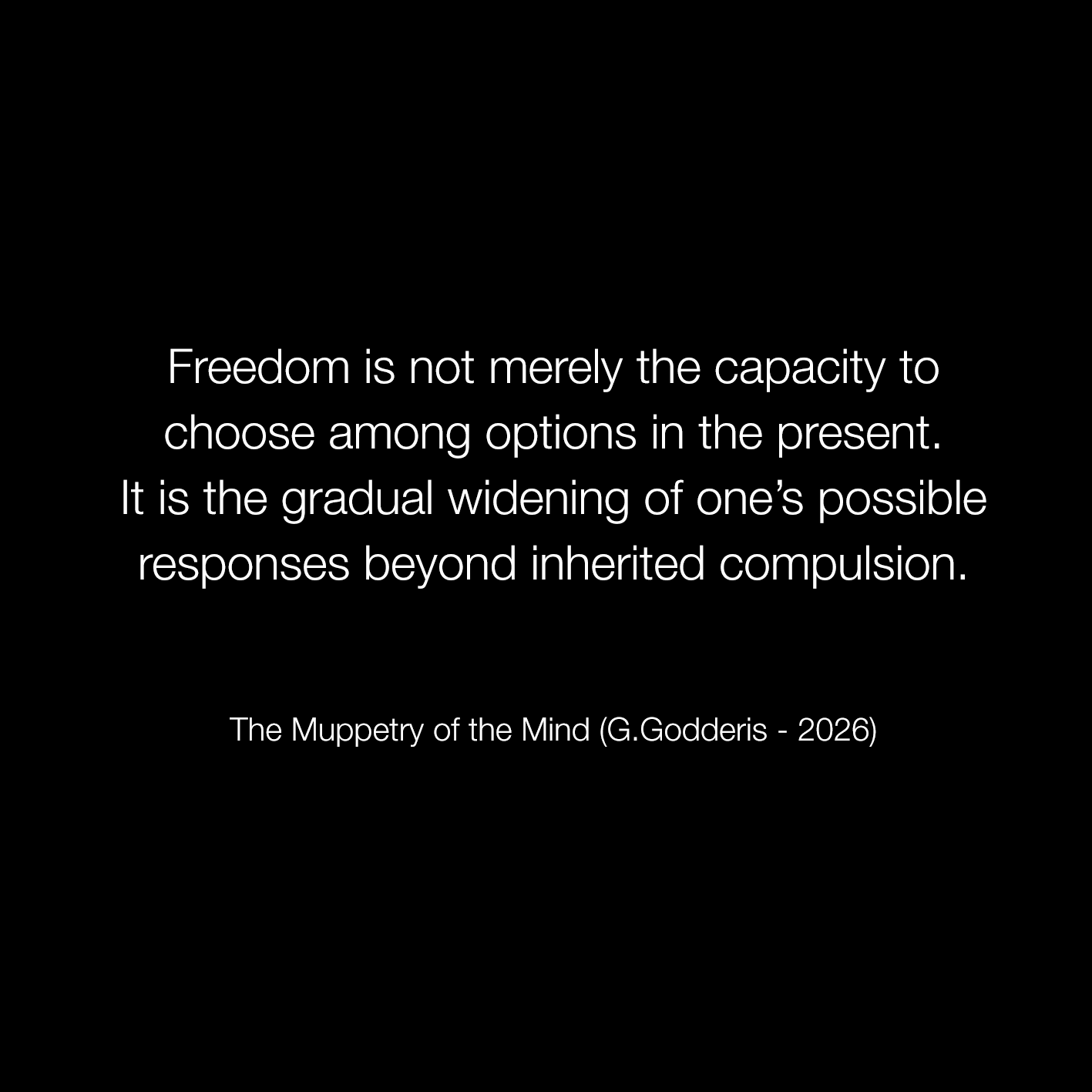
The Muppetry of the Mind is an original philosophical manuscript where I reimagine the human mind as plural, performative, relational, and fundamentally unfinished. Its central concept, “muppetry,” does not name stupidity or mere chaos, but the stitched, animated, excessive, and often theatrical character of mental life itself. I point to the fact that the human mind is never simply a unified interior core. It is composed of impulses, inherited narratives, social roles, symbolic forms, embodied habits, inner performances, and visible seams that do not disappear simply because we call them a self.
Against models of consciousness that assume stability, transparency, or sovereign unity, the manuscript argues that selfhood is better understood as something staged, assembled, negotiated, and lived through contradiction. In this sense, the mind appears not as a throne of pure reason, but as a dynamic field in which memory, desire, fear, ritual, language, imagination, and reflection remain in constant interplay. Muppetry names precisely this condition: the strange dignity of beings who are never seamless, yet still capable of meaning, responsibility, and transformation.
Drawing across a broad range of philosophical and cultural traditions, from Plato and Augustine to Buddhist no-self, Daoist attunement, Indian theories of mind, African relational personhood, Indigenous cosmologies, Sufi understandings of the heart, psychoanalysis, and contemporary thought on technology and artificial intelligence, the manuscript develops a wide-ranging and original account of what it means to become a self. In doing so, it asks not only what the mind is, but also what kind of world the mind requires in order to flourish.
At its core, the manuscript is also my reflection on the present human condition. It addresses algorithmic attention, ideological scripting, fractured identity, grief, education, ritual, and the future of humane intelligence in an era increasingly shaped by machines and by forms of thinking that flatten complexity rather than deepen it. The Muppetry of the Mind thus stands as both a philosophy of consciousness and a philosophy of civilization: my sustained inquiry into what kind of beings we are becoming, and whether a more reflective, relational, and humane future remains possible.