History is rarely shaped by those who shout the loudest. Noise can dominate a moment, but it seldom endures. What is loud often mistakes itself for what is lasting. It demands attention, fills the air, claims the center, and yet so often disappears as quickly as it arrived. Volume is not depth. Spectacle is not substance. And history, despite all the illusions of power, is ultimately written not by noise, but by moral persistence.
What truly alters the course of the world are not always the voices that rise highest, but the consciences that remain steady when everything around them invites surrender. The men and women who change history are often those who refuse a more subtle defeat: the acceptance of darkness as final, the temptation to believe that cruelty is realism, that fear is wisdom, that despair is maturity.
Darkness has always tried to present itself as truth. It speaks in the language of inevitability. It tells us that injustice is simply the way of the world, that violence is natural, that dignity is fragile, that hope is naïve. But history moves forward each time someone rejects that logic. Each time a person, a people, or a generation decides that darkness may be real, but it does not have the right to define the limits of light.
That is perhaps one of the deepest human responsibilities: not merely to endure darkness, but to contest its authority. To insist that the night is not sovereign. To refuse the claim that what is broken is therefore permanent. To understand that light is not just something we find, but something we make, protect, carry, and pass on.
The people who shape history in lasting ways are not always those who conquer. Often, they are those who remain inwardly unconquered. Those who continue to think clearly in an age of manipulation. Those who continue to speak carefully in an age of shouting. Those who continue to build, teach, heal, write, shelter, resist, and imagine, even when the atmosphere around them is thick with collapse.
Because light is not only brilliance. It is orientation. It is the quiet capacity to discern another way when the age insists there is none. It is ethical imagination. It is courage without theatricality. It is the stubborn discipline of refusing to let the worst thing in the room become the measure of reality.
And that is why history belongs, in the end, not to the loudest, but to the steadfast. To those who understand that darkness is never defeated by imitation, but by contrast. Not by becoming harder, emptier, or more merciless than it is, but by remaining faithful to what it cannot produce on its own: clarity, conscience, tenderness, meaning, vision.
The future is never secured by those who merely denounce the dark. It is shaped by those who widen the field of light. Those who keep a door open. Those who protect language from corruption. Those who defend the fragile before fragility is mocked. Those who continue, against all pressure, to act as if humanity is still worth the effort.
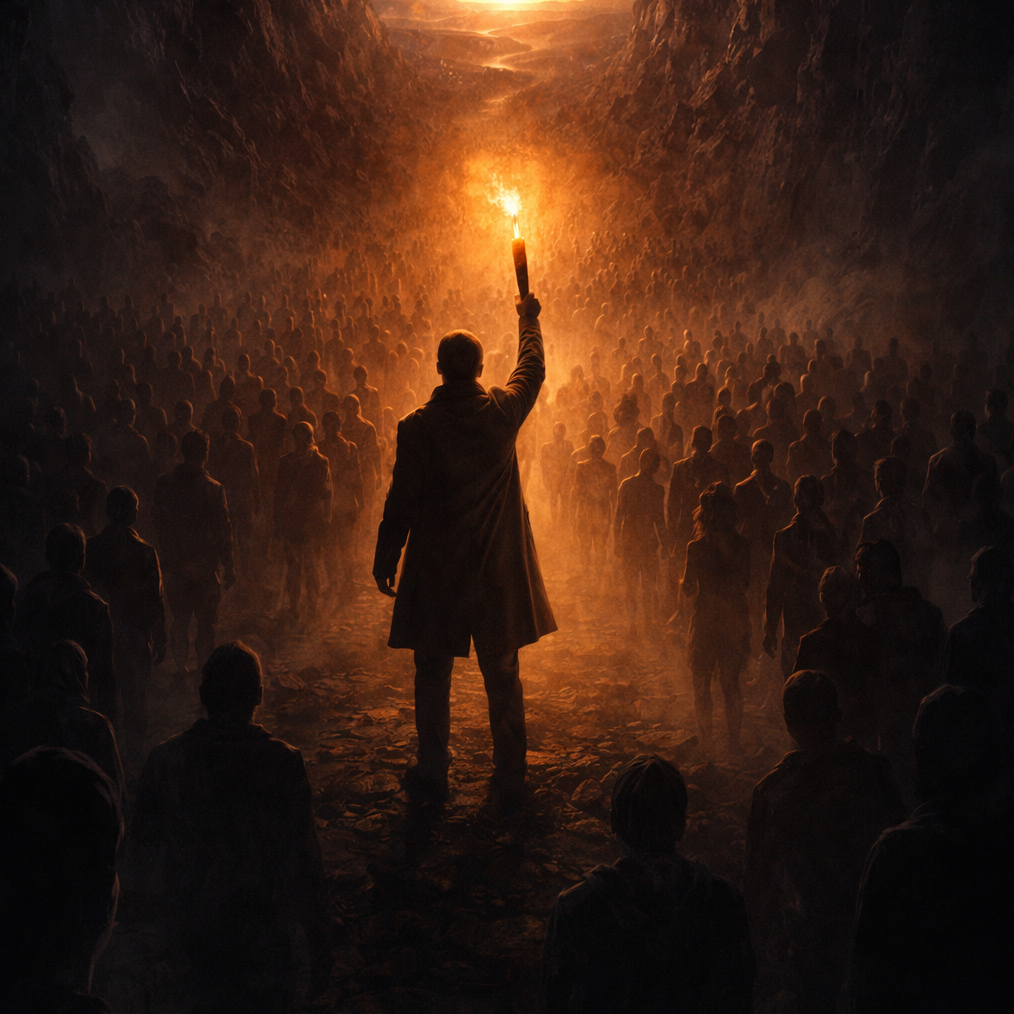
History does not finally remember who made the most noise. It remembers who kept the flame alive when the age grew cold. Who refused simplification when the world demanded slogans. Who refused hatred when hatred seemed efficient. Who refused to let darkness become not only a condition, but a definition.
For darkness can surround us, threaten us, even wound us. But it only truly wins when it persuades us to lower our idea of what light can be.
And every time someone refuses that surrender, history shifts.