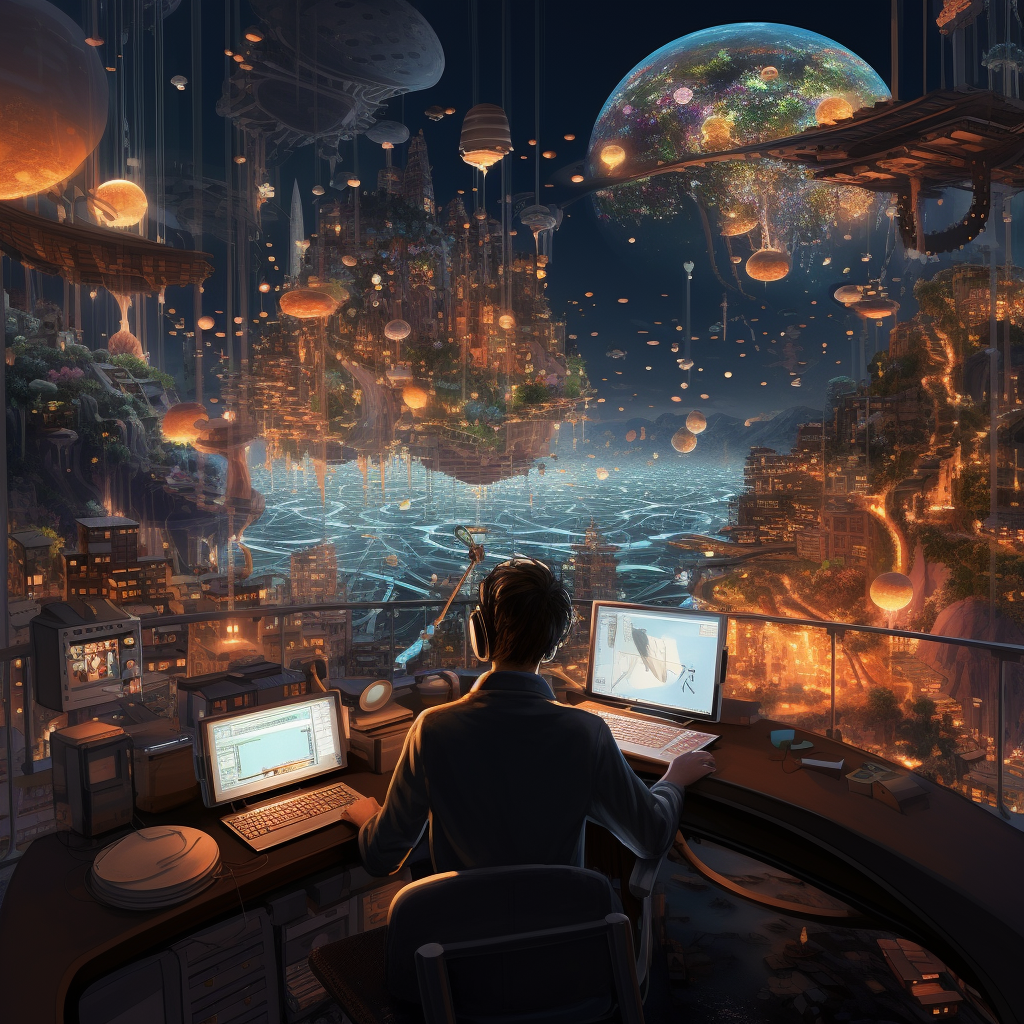
In a noospheric society, the digital artist is no longer only someone who creates images, objects or aesthetic experiences. The digital artist becomes someone who activates meaning. Their work does not simply exist to be looked at. It exists to be entered, shared, questioned and continued.
This is one of the essential differences between digital art and many older forms of art. A painting can of course provoke thought, emotion and discussion. But digital art often moves immediately into a wider field. It appears on screens, platforms, feeds, online galleries and social spaces. It can be copied, remixed, commented on, misunderstood, defended and transformed almost instantly. The artwork becomes less of a final object and more of a living event.
In that sense, the digital artist becomes a catalyst of public conversation. Their work can open discussions about identity, technology, power, memory, intimacy, loneliness, artificial intelligence, surveillance, beauty, ethics and the future of the human being. It does not merely illustrate these subjects. It gives them form. It makes them visible and emotionally present.
This role becomes increasingly important in a society where technology evolves faster than our ability to understand it. Artificial intelligence, big data, virtual reality, algorithmic systems and synthetic media are no longer distant concepts. They are already shaping how we work, communicate, desire, remember and imagine ourselves. Yet for many people, these systems remain abstract and obscure. We use them, but we do not always understand them.
The digital artist can help break that obscurity.
Not by reducing complex technologies to simple explanations, but by making them felt. An artwork can reveal what a technical diagram cannot. It can show the emotional weight of data, the strangeness of artificial intelligence, the seduction of virtual worlds, or the hidden violence of systems that pretend to be neutral. The artist becomes a translator between technological complexity and human experience.
But the digital artist also has another task. In a world where data becomes one of the main ways in which people are measured and valued, the artist reminds us that a human being is more than a profile, a pattern or a prediction. Data can describe certain contours of a life, but it cannot contain the whole of that life. It can record behaviour, but not always meaning. It can map choices, but not wounds. It can predict habits, but not the mystery of a person.
Digital art often works inside that tension. It uses the tools of technology, but it also resists the reduction of the human being to technology. It can use code, algorithms, sensors, images and networks, while still insisting on emotion, memory, fragility and ambiguity. It reminds us that not everything valuable can be calculated.
As the border between the virtual and the real becomes less clear, the ethical role of the digital artist also grows. The noosphere will not only be a space of knowledge and connection. It will also be a space of power, manipulation, seduction and control. We will have to ask not only what technology can do, but what it should do. What should be made visible? What should remain private? What kinds of images shape our desires? What systems are we allowing to think for us? What parts of ourselves are we giving away too easily?
Digital artists can bring these questions into the public field. Through interactive installations, bio-art, generative images, virtual environments, data visualizations and AI-driven works, they can create experiences that force us to pause. They do not always need to give answers. Sometimes their role is more important than that. They make the question impossible to ignore.
Every society needs people who can imagine otherwise. People who can sense possible futures before they become ordinary. In our increasingly digital and interconnected world, digital artists are among those visionaries. They show us not only what technology might become, but what we might become through technology. They reveal both the promise and the danger: the expansion of human ability, but also its possible corruption; the beauty of connection, but also the risk of dependency; the dream of shared knowledge, but also the loss of depth.
The digital artist does not stand outside this world, observing it from a safe distance. The artist is inside the web, using its tools, speaking its language, disturbing its habits. Their work participates in the formation of the noosphere itself. It shapes how we see, how we respond, how we connect and how we imagine the future.
So the digital artist in a noospheric society becomes much more than a creator of digital works. They become a mediator between technology and humanity. A guardian of emotional depth. A maker of ethical discomfort. A translator of invisible systems. A builder of possible futures.
Their work does not simply decorate the digital world.
It changes how we understand it.
And perhaps, more importantly, how we choose to live within it.
The digital artist does not merely find a way.
Where no path exists, the digital artist makes one.