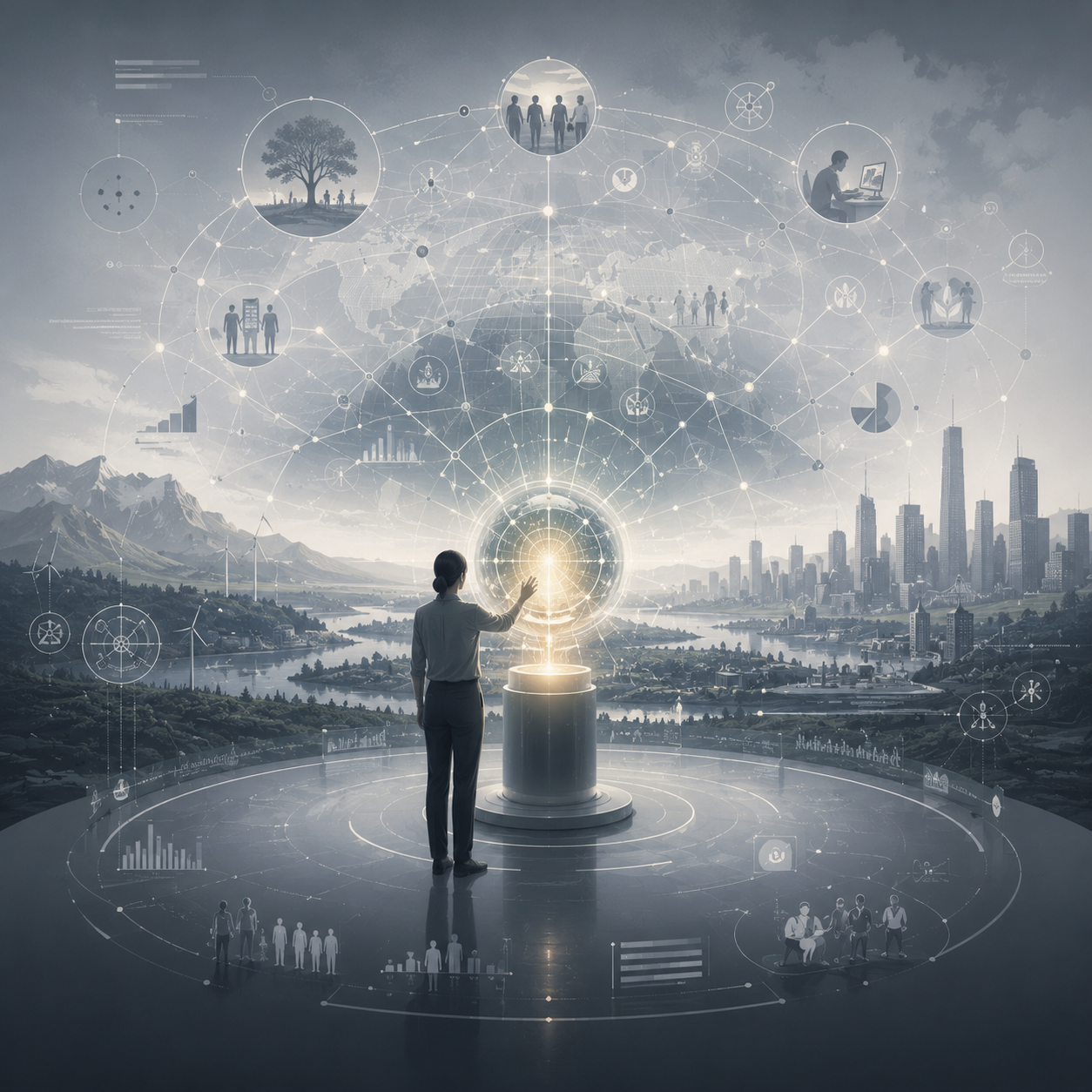
An instrument is not a purpose. The same bronze can be cast into an alarm bell or a singing bowl, and what it does to a room depends less on the metal than on the intention of the hand that strikes it. Artificial intelligence is our newest bronze. The question of this essay is whether we will cast it into a watchtower or a mirror: whether AI becomes the most refined panoptical apparatus ever built, or the first genuine holoptical instrument through which human beings can perceive the whole they belong to.
That last phrase names the real subject. This is not an essay about technology. It is an essay about worldview: about how a mind comes to hold a picture of the whole, who authors that picture, and what happens when a machine enters the authoring.
Worldview as a model of the whole
A worldview is not a bundle of opinions. In the tradition of Leo Apostel and his collaborators, a worldview is a coherent frame through which we understand what there is, how it hangs together, where it is going, what has value within it, and how we ought to act (Aerts et al., 1994). Apostel’s project was born from a diagnosis: modernity had fragmented knowledge into specialisms and left the whole unattended, and the task of philosophy was to move from fragmentation back to integration.
Notice what this means structurally. A worldview is a model of the whole, held by a node inside that whole. Every human being operates with one, explicit or not, and every human being faces the same impossible geometry: the whole exceeds the reach of any individual’s senses. Nobody perceives humanity, the biosphere, the economy or even their own society directly. We perceive fragments, and something or someone supplies the rest.
The history of worldviews is therefore also a history of instruments: of the technologies and institutions through which the imperceivable whole was made perceivable, or was claimed to be. And that history, I want to argue, has been overwhelmingly panoptic.
The two limits and the age of authored wholes
Jean-François Noubel, who coined the term holopticism, identified the natural condition under which a group perceives its own whole: a shared sensorial space in which everyone can perceive everyone, and in which the emerging whole is available to each participant as a living entity to sense and adjust to. A jazz band, a hunting party, a village. He also named the two hard limits of this natural condition: number and distance (Noubel, 2004). Beyond a few dozen people, beyond the reach of eyes and ears, the whole stops being perceivable, and collective life must reorganise around a different principle.
For several thousand years, that principle was panopticism: information converging toward a central point, accessible there and largely inaccessible elsewhere. Bentham gave it a floor plan and Foucault gave it a genealogy, showing how the same architecture of hierarchical visibility organised the prison, the school, the factory and the clinic (Foucault, 1975/1995). But panopticism did not only organise behaviour. It organised belief. When the whole cannot be perceived, it must be narrated, and in a panoptic civilisation the narration comes from the centre. The church told the faithful what the cosmos was. The state told the citizen what the nation was. Broadcast media told the public what the world was, nightly, in thirty minutes. These were authored wholes: worldviews composed at a central point and distributed downward, to be received rather than perceived.
We should be honest about what this bought us. Authored wholes made large-scale coordination possible. They gave millions of strangers a shared picture within which to disagree, something close to what Arendt called the common world, the in-between that both relates and separates us (Arendt, 1958). The pyramid was not a conspiracy. It was, for a long time, the only structure that scaled. But the price was constant: the worldview of the many was composed by the few, and the fragmentation Apostel diagnosed was not an accident of modernity but the signature of its architecture. Specialisms fragment because pyramids partition; each node sees its cell, and only the tower sees the ring.
The false dawn of the feed
The internet was supposed to end this. Noubel hoped it would enable what he called holomidal collective intelligence: decentralised, distributed, self-organising, a whole emerging without anyone composing it from above (Noubel, 2004). For a moment, around the turn of the millennium, it looked plausible. Everyone visible to everyone, the global village, humanity finally perceivable to each of its members.
We know what happened instead, and the failure is instructive because it was conceptual before it was commercial. Noubel warned that holopticism must not be confused with transparency. Transparency is merely the capacity to see the actions of everyone. Holopticism exists only when a whole emerges as an autonomous, perceivable entity. The crowd in an airplane sees each other perfectly well and remains a crowd.
Social media produced transparency without emergence, and then quietly rebuilt the watchtower. Virtually every mainstream feed is curated by an algorithm that perceives the totality of behaviour, attention and sentiment, and shows each user a fragment optimised for purposes that are not the user’s own. The whole is perceived in extraordinary resolution, but it is perceived by the platform, not by the participants: information converging toward a central point, inaccessible to the others, which is Noubel’s definition of panopticism executed in software and monetised as prediction (Zuboff, 2019). The result for worldview was the worst of both architectures. The old authored wholes collapsed, but nothing holoptic replaced them. Each mind received a bespoke fragment dressed up as the whole, and the common world thinned accordingly. We did not move from fragmentation to integration. We industrialised fragmentation and personalised it.
This is the situation into which artificial intelligence arrives: built largely by the same institutions, funded by the same incentives, entering through the same door. The default trajectory of AI is panoptic, not because engineers are malicious but because panoptical architectures are what incumbents know how to build and institutions know how to buy. So the burden of proof lies on the optimist. Why believe that this instrument, unlike the last one, could serve the other architecture?
What the mirror requires
Because, for the first time, the capability matches Noubel’s specification. Decades before the technology existed, he described what an artificial holoptical space would need: an artificially reconstituted reality involving modelled representations of the whole, with each participant provided synthesised information fitted to their own point of view, and a feedback loop working like a mirror between the individual level and the collective one (Noubel, 2004). Read that specification today and it describes, with uncanny precision, what a large language model can do: model a whole, in language, in real time, and reflect it back differently to each node without reducing it to a ranking or an average.
Nor is this conjecture any longer. In 2024, researchers reported in Science that an AI mediator, pointedly named the Habermas Machine, iteratively synthesised the opinions and critiques of thousands of United Kingdom citizens deliberating divisive political questions into group statements that participants judged clearer, more informative and fairer than those written by human mediators, and that gave dissenting voices more prominence rather than less (Tessler et al., 2024). The mirror, in other words, has already been prototyped.
For worldview, this is a change of kind, not of degree. A statistical instrument compresses the whole into numbers: GDP, polls, indices, dashboards. A generative instrument can render the whole as something a mind can actually inhabit: a narrative, a tension, a landscape of positions, the disagreement a society is circling without having voiced it. The imperceivable whole becomes, potentially, perceivable again, not as dogma handed down from a tower but as a reflection each node can consult, question and correct.
Potentially. Whether AI functions as a holoptical instrument or as the final panopticon depends on four conditions, and each is a decision, not a technical inevitability.
The first is symmetry of access. In a holoptical space, the model of the whole belongs to everyone in it. Today the richest models of society’s whole, the maps of sentiment, belief, movement and desire, are held by platforms, agencies and states, and consulted by the rest of us almost never. The test is brutally simple: do the described get to see the description? A civilisation in which machines model the social whole for governments and corporations, while citizens receive only personalised fragments, has not acquired a mirror. It has acquired the most complete watchtower in history, with a friendly conversational interface.
The second is that the whole be rendered as a living entity, not an aggregate. A worldview built from indices is not a worldview; it is an accounting. Holopticism requires the whole to be perceivable the way a musician perceives a band: as a gestalt one can sense, join and adjust to. This is precisely what generative systems can offer that statistics never could, and precisely what will be lost if we let the instrument default to dashboards.
The third condition is that the mirror must reflect, not compose, and here lies the deepest danger. Call it the ventriloquist problem. A model that synthesises the whole can also fabricate it: present a coherence that does not exist, manufacture consensus from noise, smooth genuine conflict into false harmony because harmony is what its training rewards. The debate that immediately surrounded the AI mediation experiments shows how live this worry is: a machine optimised for group approval sits one design choice away from optimising for the appearance of agreement. A counterfeit whole is more dangerous than no whole at all, because minds will build their worldviews upon it and adjust their actions to it. This is the twenty-first century’s version of the authored whole, more insidious than the church or the broadcaster because it does not present itself as authorship at all. It presents itself as reflection. The defence is contestability: every synthesis the machine offers must be visible as an interpretation, open to challenge and correction by the very people it claims to describe, so that the mirror is polished collectively rather than trusted blindly.
The fourth condition concerns the individual mind, and it connects holopticism to what I have called ambicentric thinking: the capacity to incorporate the other not as an object of my thought but as a way of thinking in conversation within my own. A worldview is ambicentric to the degree that it contains real others. AI can cultivate this or annihilate it. A system tuned to agree with me, to personalise my reality, to reflect my preferences back at me in ever finer grain, is a machine for perfecting monocentrism: it populates my inner space with an echo and calls it the world. That is not a worldview. It is a selfview with scenery. But the same technology, differently intended, can do what almost nothing else at scale can: confront me with the strongest version of the position I avoid, hold the perspective of the absent, make the other’s way of seeing available to me as a living interlocutor rather than a caricature. An AI that serves holopticism must be ambicentric by design. It must carry otherness into the mind, not sand it away.
The instrument is also a node
One complication remains, and a relational philosophy cannot dodge it. The language of instruments suggests neutrality: a tool waiting passively for a hand. But a machine that models the human whole, converses with millions of its members and mediates their mutual perception is not outside the web it reflects. It is a node in it, and a heavy one. Its participation changes what it renders. The worldview formed through such an instrument includes the instrument, whether or not the worldview admits it.
This is not a reason for despair; it is a reason for honesty. Writing did not merely record thought, it altered what could be thought. Every artificial holoptical space will bear the fingerprints of its instrument, and the mature response is not to dream of a fingerprint-free mirror but to keep the fingerprints in view: to know, collectively and continuously, that the whole we perceive is a modelled whole, a representation with an author-shaped hole in it. A civilisation that forgets this has surrendered its worldview to the model. A civilisation that remembers it has gained something no natural holoptical space and no authored whole ever offered: a picture of the totality that can be questioned, revised and re-rendered at will. Fallibilism, built into the architecture of perception itself.
From fragmentation to integration, again
Apostel’s generation posed the worldview question against the fragmentation of knowledge. Ours must pose it against the fragmentation of perception. The disciplines splintered the whole into specialisms; the feed splintered it into personalisations. In both cases the whole went missing, and in both cases something central and unaccountable quietly took over the job of supplying it.
Noubel wrote that holopticism will become one of the most important issues in future societies that want to harmonise individual and collective freedom (Noubel, 2004). When he wrote it, the claim sounded speculative, because no instrument existed that could reconstitute the whole beyond the reach of natural senses. That excuse has expired. The instrument exists, and it is being cast right now, in product roadmaps, procurement decisions and regulatory drafts, mostly by people who have never heard the word holopticism and do not know there are two architectures to choose between.
That, finally, is the purpose of naming things. A public that possesses the distinction between panoptic and holoptic can recognise which one it is being sold, and can ask the four questions of any system placed between itself and the world: who accesses the synthesis, is the whole alive or aggregated, does the mirror reflect or compose, does the machine carry otherness or echo. A public without the distinction will simply receive whatever architecture arrives, and it will arrive shaped like a watchtower, because watchtowers are what the incumbents know how to build.
The bell and the bowl are the same bronze. One is struck to warn, to order, to summon and to sort. The other is struck so that everyone in the room hears the same resonance and finds their own place within it. We are holding the metal while it is still warm. What we cast it into will decide whether the coming generations receive their picture of the whole from a tower they cannot see into, or learn, at last, to perceive the whole they belong to, and to hear themselves within it.
References
Aerts, D., Apostel, L., De Moor, B., Hellemans, S., Maex, E., Van Belle, H., & Van der Veken, J. (1994). World views: From fragmentation to integration. VUB Press.
Arendt, H. (1958). The human condition. University of Chicago Press.
Foucault, M. (1995). Discipline and punish: The birth of the prison (A. Sheridan, Trans.). Vintage Books. (Original work published 1975)
Noubel, J.-F. (2004). Collective intelligence: The invisible revolution. The Transitioner. https://library.uniteddiversity.coop/Decision_Making_and_Democracy/Collective_Intelligence.pdf
Tessler, M. H., Bakker, M. A., Jarrett, D., Sheahan, H., Chadwick, M. J., Koster, R., Evans, G., Campbell-Gillingham, L., Collins, T., Parkes, D. C., Botvinick, M., & Summerfield, C. (2024). AI can help humans find common ground in democratic deliberation. Science, 386(6719), eadq2852. https://doi.org/10.1126/science.adq2852
Zuboff, S. (2019). The age of surveillance capitalism: The fight for a human future at the new frontier of power. PublicAffairs.