Why Things Are as They Are
When I first gave a version of this argument in 2022, we were barely out of the pandemic. Four years later the masks are gone, but the questions the pandemic exposed have not been answered. If anything, they have sharpened. So let me begin where I began then, with a confession: I am reluctant to talk to teachers these days. Not because I dislike them, but because every conversation follows the same script, ends at the same wall, and leaves me wondering whether the problem is the people or the architecture they inhabit. This essay is my attempt to understand that architecture. Not to complain about it, but to ask a more useful question: why is it built the way it is?
Because here is the thing we rarely notice. Children everywhere are required by law to attend school. Almost all schools are structured in more or less the same way. Societies spend enormous effort and money to provide them. Faced with such universal agreement, we naturally assume there must be a good, logical reason behind it all. Perhaps, we think, if we did not force children to school, or if schools operated very differently, children would simply not grow up into competent adults.
But what if the system we have is not the product of logic or evidence at all? What if it is simply the product of history? The educational psychologist Peter Gray has made exactly this argument: to understand why schools are what they are, we must abandon the idea that they are products of scientific insight and view them instead as historical artefacts (Gray, 2008). Once you see the system that way, its strangest features suddenly make sense. And its stubbornness, too.
Learning before schools
For the overwhelming majority of our existence as a species, there were no schools. Children in hunter-gatherer societies educated themselves through self-directed play and exploration. Measured against the biological history of humanity, schools are a very recent invention.
This was not neglect. Adults in hunter-gatherer cultures allowed children almost unlimited freedom to play and explore because they recognised, correctly, that these activities are children’s natural way of learning. Anthropological studies of contemporary hunter-gatherer communities confirm the pattern again and again. Crucially, in those cultures there was no sharp distinction between work and play. Adult activity was skill-intensive and knowledge-intensive, and the border between playing at life and living it was porous. That distinction, work here, play there, is a cultural artefact. We invented it. And, as we will see, we then built our schools on top of it.
Agriculture: children become labour
Agriculture changed everything. Farming produced more food, which allowed larger families and permanent settlement. But it also transformed the nature of labour. A hunter-gatherer harvests what nature provides; a farmer must plough, plant, tend, and guard. Successful farming demanded enormous quantities of labour, and children supplied much of it. They worked the fields, minded siblings, kept the household running. Whatever we might call education evaporated into chores.
Agriculture brought something else as well: land ownership and the accumulation of property, and with them status differences between people, and therefore between children. By the Middle Ages, society had hardened into hierarchy, with lords above and servants and serfs below. Most people, children included, existed to serve someone else. Gray quotes a French count’s advice on the training of a huntsman’s boy servant, from a document of the late fourteenth or early fifteenth century, that still stuns me every time I read it: choose a boy as young as seven or eight, and beat him until he has “a proper dread of failing to carry out his master’s orders” (Orme, 2001, as cited in Gray, 2008).
That is not ancient history. That is the moral universe from which our institutions climbed.
Industry: the suppression of play
The Industrial Revolution replaced feudal lords with factory owners, but for children the change was mostly a change of scenery, and not for the better. Labour moved from fields, where there was at least sunlight and the occasional chance to play, into dark, crowded factories. Children died there in numbers that nobody bothered to count carefully.
Progress, when it came, came slowly and reveals its own horror in the fine print. In England, legislation of 1883 forbade textile manufacturers from employing children under nine, and limited the working week to 48 hours for ten to twelve year olds and 69 hours for thirteen to seventeen year olds (Mulhern, 1959, as cited in Gray, 2008). Read that again. A 69 hour week for a fourteen year old was the reform. That was what doing well by children looked like.
And throughout this whole era, the child’s instinct to play was treated not merely as an inconvenience but as a vice to be eradicated. John Wesley’s rules for the Wesleyan schools stated it with chilling clarity: there would be no play days and no time for play on any day, “for he that plays as a child will play as a man” (Mulhern, 1959, as cited in Gray, 2008). Willfulness and playfulness, once simply the way children lived and learned, became defects to be beaten out.
Schools arrive, but for whose benefit?
As industry automated, the raw need for child labour declined, at least in parts of the world, and the idea spread that childhood should be a time for learning. Schools were built. This sounds like the happy ending, but look at who built them and why.
Employers in industry saw schooling as a way to create better workers. The crucial lessons, from their perspective, were punctuality, obedience to direction, and tolerance for long hours of tedious work. The ability to read and write ranked well below these. National governments added their own curriculum: the glories of the fatherland, the virtues of its founders, and the necessity of defending the nation against evil forces.
Nobody at the time was thinking about children constructing their own understanding. The task was the implanting of approved truths, and the only known method of implantation was forced repetition and testing from memory. Recite, memorise, repeat, like a parrot, without any requirement to think.
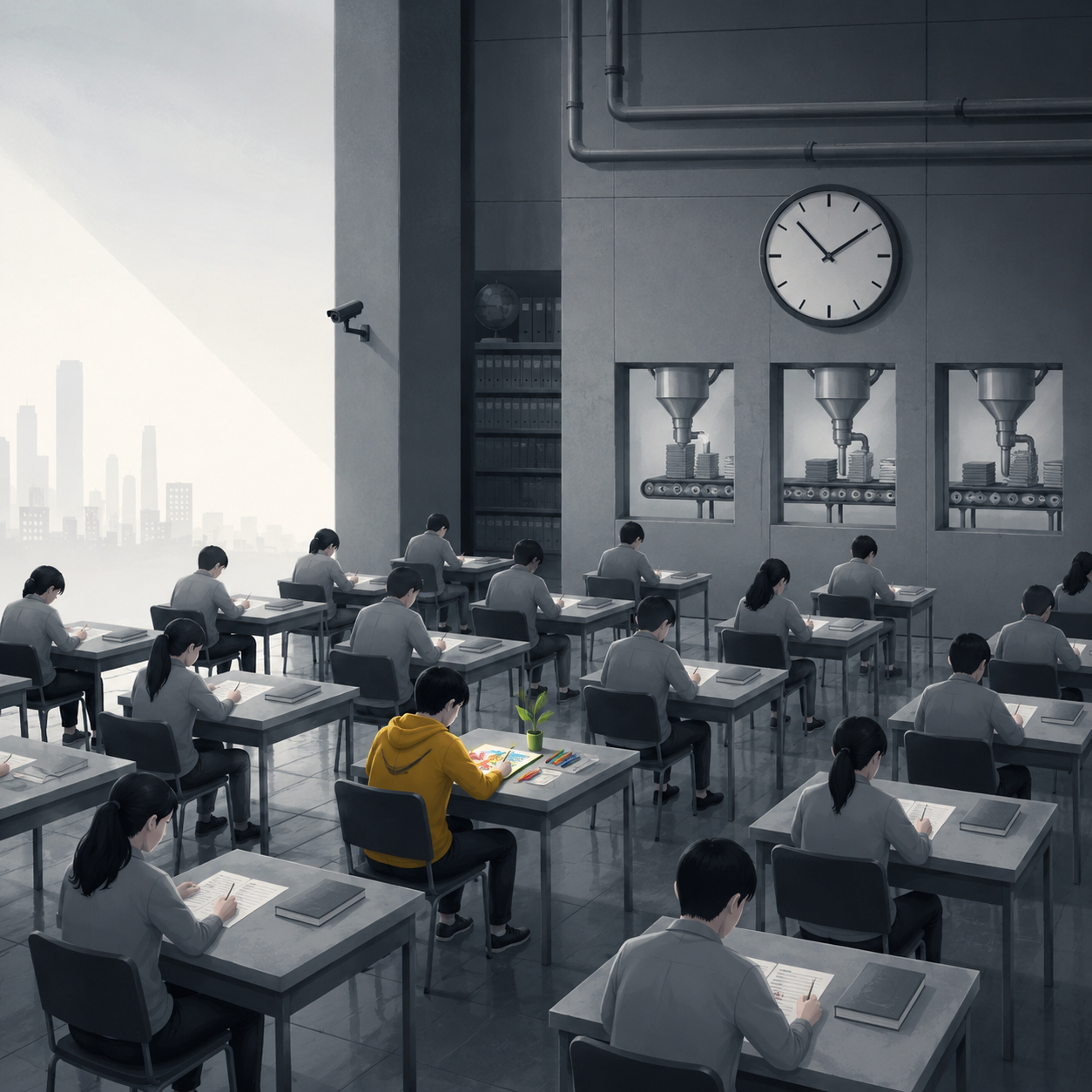
And here is the decisive move, the one that still governs your child’s Monday morning: school became work. The methods of the factory floor, standardisation, supervision, output measurement, discipline, were transferred wholesale into the classroom. School is the place where children learn the distinction our hunter-gatherer ancestors never made, the distinction between work and play, and learn that the first is virtuous and the second is waste.
The system today: yesterday’s solution to yesterday’s problem
In recent times the methods have softened. We no longer beat children, and we congratulate ourselves for it. But the underlying assumptions have barely moved. Learning is still framed as work: something unpleasant that children must be made to do, rather than something that happens naturally when curiosity is left intact. The activities are still not the children’s own; the lessons are determined by professional educators, and the child’s task is compliance.
The standardised curriculum and the obsession with ranking and grading were designed for the industrial age, to sort a mass of future workers efficiently. That design brief no longer exists. The system built for it remains, fully operational, solving yesterday’s problem with yesterday’s tools.
The trouble with grades
Consider grades, the load-bearing wall of the whole structure. Educated individuals like Jefferson, Shakespeare, Galileo and Plato were never given grades, yet grades now define the contours of our entire meritocracy. The best jobs go to students with the best grades from the best universities, which accept students with the best grades from the best schools. There is only one problem with that sentence, and it is the word “best.”
Grades corrupt learning in at least four ways.
First, they create risk-averse behaviour. Because shame attaches to a low mark and pride to a high one, students learn to choose the path of least resistance to the easy A. The designer Marcel Wanders once provocatively suggested that doing a good project in school should be forbidden, that students should make as many mistakes as possible. He is right about the underlying principle: education should be a safe haven for failure, a place of constant iteration and rapid prototyping, where bouncing back from mistakes is itself the curriculum. Grades teach the opposite. They teach students never to attempt anything they might fail at.
Second, grades become the end goal rather than the means. Every parent knows the question, and I have heard it from my own children more times than I can count: “Do we have to know this for the test?” It sounds innocent. It is devastating. It means the grade, originally intended as an instrument of learning, has been transformed into the purpose of learning. Students memorise the details necessary to pass and discard comprehension as excess baggage. I did it myself as a student: walk out of the exam, and the knowledge walks out with you. Laszlo Bock, then Google’s head of people operations, put it bluntly: grades are worthless as a criterion for hiring, because they predict nothing (Bryant, 2013).
Third, grades are an impoverished form of feedback. Feedback is essential to learning; it is how we improve, and qualitative learning has no natural endpoint, because we remain pupils for the rest of our lives. But a grade signals the end of a learning process. It is a full stop where there should be a comma. There is a world of difference between “you scored a four out of ten” and “this approach did not work, let us try another one.” The first closes a door. The second opens one. And grades quietly poison the relationship between teacher and student too: people talk differently to a child with high marks than to a child with low ones, and children feel it.
Fourth, and here is the paradox that keeps the system alive: grades are convenient. They are easy to produce, easy to store, easy to transmit, easy to compare across masses of people. For an administration, they are a dream. For a learner, they are an environment that restricts innovation, restricts creativity, implies failure, and undermines the personal relationships through which real learning travels. We keep them not because they serve children but because they serve the system.
2026: the stakes have only risen
When I first made this argument, the pandemic had just torn the roof off the school and let everyone see inside. Parents watched, at close range, how their children were actually being taught, and many did not like what they saw. The children who suffered most were, predictably, the ones who were not the average student. In Belgium, and I suspect elsewhere, if you are not the average student, you fall out of the system. It does not require a diagnosis or a label. Not average is enough.
Since then, a second stress test has arrived, and it is a bigger one. Generative artificial intelligence can now produce, on demand, exactly the kind of output our schools were designed to extract from children: the memorised summary, the standard essay, the correct answer to the predictable question. A system built to train reliable reproducers of known information has just watched machines master reproduction. Every argument I made in 2022 about the obsolescence of industrial-age schooling has been made for me, in eighteen months, by technology. The question is no longer whether the old model is outdated. The question is what we intend to do about it.
The answer, I believe, points in the same direction it always did, only more urgently. Education must move from dictation to exploration. Its aims should be critical thinking in the most extensive sense, the genuine production of knowledge rather than its reproduction, and the development of the individual child: their social identity, their self-creation, without prescribing every step for them. A teacher’s task, as one of our own policymakers once put it, is to lead students into discovering new things. That means providing spaces for real discussion, teaching children to listen to other voices, to tolerate criticism and difference, to cooperate, to argue dialectically, and above all to think for themselves. Children educated that way do not merely learn to handle the problems of the past. They develop the capacity to handle problems that do not yet exist, which is, if we are honest, the only guarantee education can meaningfully offer. This means intensive coaching and mentoring in place of ranking and sorting: personal feedback instead of numerical verdicts, the unlocking of an individual’s potential instead of their classification.
“Because it works”
Which brings me back to my reluctance to talk to teachers. Many parents are critical thinkers. Many of us try, patiently and in good faith, to engage with the system, to ask why. Why grades? Why tokens for compliance? Why the same structure for every child when we can all see it failing the ones who deviate from the average? And whenever I ask, whether at a large school or a tiny one of forty pupils, I receive, with remarkable consistency, a single argument:
Because it works. It has worked for forty years.
That is not an argument. It is the sound a system makes when it has forgotten why it exists. A system that persists because of the system, and not because of the child, has inverted its own purpose. Our schools are not the product of logic; they are the product of a history of children as labourers, of play as vice, of learning as work, and of measurement as meaning. Knowing that history does not solve the problem. But it dissolves the illusion that things are as they are for good reasons, and that is where every real change begins.
The forty years are over. It is time to build something worthy of the next forty.
References
Bryant, A. (2013, June 19). In head-hunting, big data may not be such a big deal. The New York Times. https://www.nytimes.com/2013/06/20/business/in-head-hunting-big-data-may-not-be-such-a-big-deal.html
Gray, P. (2008, August 20). A brief history of education. Psychology Today. https://www.psychologytoday.com/us/blog/freedom-learn/200808/brief-history-education
Gray, P. (2013). Free to learn: Why unleashing the instinct to play will make our children happier, more self-reliant, and better students for life. Basic Books.