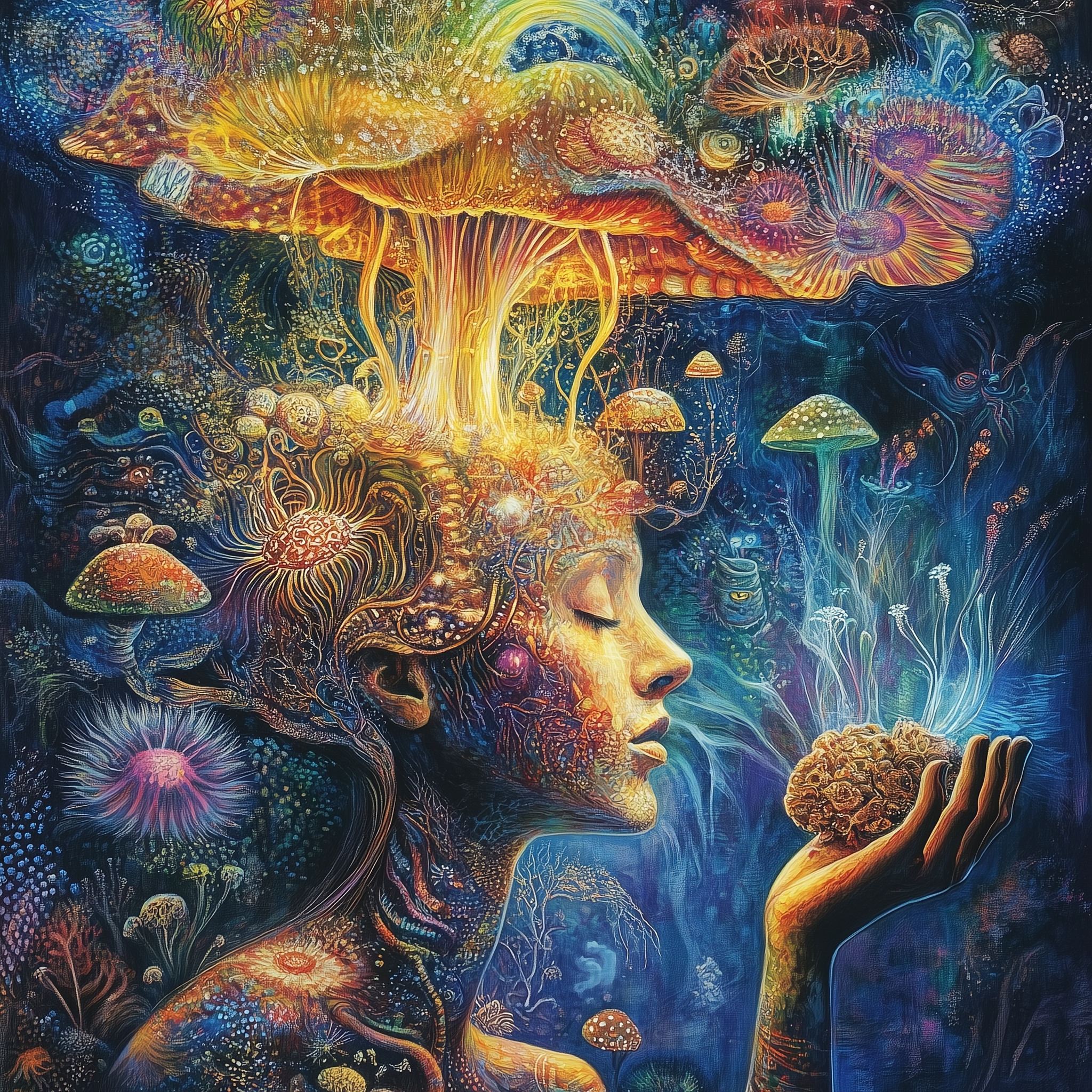
I believe that the way we understand the human mind may need to be reshaped, or at least disturbed, by looking more closely at naturally occurring psychedelics. Especially those substances, like psilocybin, that enter the body as something still becoming. For years, Theory of Mind has been one of the central models through which we try to understand how people perceive the inner states of others, and of themselves. It gives language to empathy, self-awareness, social cognition, projection, misunderstanding.
But perhaps it also assumes too much.
Theory of Mind often begins with the idea of a self. A relatively stable “I” that looks outward, interprets, infers, imagines. I see you. I imagine what you feel. I understand that you have thoughts, intentions, fears, desires, distinct from mine. This is already a remarkable human capacity. It allows communication, relationships, care, manipulation, teaching, love.
And yet psychedelics seem to trouble that entire structure. Substances such as psilocybin, DMT and mescaline, many of them rooted in mushrooms, plants and long spiritual traditions, do not simply alter perception. They seem to alter the architecture from which perception arises. They do not only change what one sees. They change the position from which one sees. They disturb the borders of the self. They loosen identity. They create moments in which the “I” is no longer as solid, as fixed, as sovereign as it believed itself to be. This interests me deeply.
Because if the self is not fixed, then what exactly is Theory of Mind built upon?
At its core, Theory of Mind explains how we understand that other people have minds of their own. But it often does so from the viewpoint of a coherent observer. A stable subject interpreting another stable subject. Psychedelic experience seems to complicate that. Under certain conditions, the self becomes porous. The border between inner and outer, between me and world, between my feeling and your feeling, begins to blur.
This is where ego dissolution becomes important.
Ego dissolution is often described as the temporary loss or softening of one’s ordinary sense of self. Not necessarily as disappearance, but as expansion. The usual boundaries fall away. One no longer feels sealed inside the small private chamber of identity. One may feel connected to others, to nature, to the cosmos, to something that feels larger than the individual mind.
This could fundamentally change how we think about empathy. Traditional Theory of Mind often frames empathy as a kind of cognitive operation. I infer what you feel. I imagine what you think. I construct an internal model of your mental state. But psychedelic states suggest that empathy may not always work from the outside in. It may, in certain moments, be experienced from the inside out. Not as reasoning about the other, but as a felt participation in the other. That is a very different idea.
It suggests that empathy is not only intellectual. Not only cognitive. Not only a skill of interpretation. It may also be embodied, relational, almost atmospheric. A field in which the distinction between self and other becomes less rigid. In that sense, psychedelics may point toward a more fluid model of Theory of Mind. One in which consciousness is not always neatly divided into separate private interiors.
This also opens the question of collective mind. Many psychedelic experiences include some form of transpersonal awareness. A feeling of being connected to something larger than oneself. This may be described spiritually, ecologically, cosmically, symbolically. One person may say they felt one with nature. Another may speak of ancestors, God, the universe, or simply an overwhelming sense of belonging. Whether one interprets this literally or psychologically, the experience itself matters. Because it challenges the assumption that consciousness is only private. Perhaps consciousness is not merely something locked inside individual skulls. Perhaps it also emerges in relation, in resonance, in networks of attention and meaning. Perhaps the mind is less a sealed container and more a node in a larger web. This does not mean that individuality disappears. But it may mean that individuality is not the whole story.
Time is another part of this.
Our ordinary understanding of self depends heavily on linear time. I remember who I was. I anticipate who I will become. I use memory and projection to understand myself and others. Theory of Mind depends on this temporal structure too. We infer intentions from past actions. We predict future behavior. We build continuity. But psychedelic experiences often disturb this linearity. People describe timelessness. Or the collapse of past, present and future into one field of experience. Or the sudden return of memories with emotional force. Or the sense that a childhood wound, a present fear and a future possibility all exist together in the same room. This may sound mystical, but psychologically it is significant. If the self can be experienced outside its usual timeline, then identity may be less linear than we think. Memory, too, becomes less archival and more alive.
Not a storage room, but a field. Not a dead record of what happened, but an active structure shaping what can still happen. Psychedelics may reveal how much of the self is built from repeated stories, frozen interpretations, inherited fears and old attempts at survival. And by loosening those structures, even briefly, they may allow the mind to reorganize itself.
This is where therapy enters the conversation. In controlled and serious contexts, psychedelic research has already begun to suggest potential in relation to depression, anxiety, trauma and end-of-life distress. Not because these substances are magical solutions, and not because they should be romanticized, but because they seem capable of interrupting rigid patterns of self-perception. They may allow people to see themselves differently. To relate differently to pain. To soften defensive structures that have become confused with identity. This matters for cognitive science as well. If the brain can enter radically altered states and return from them changed, then consciousness is more plastic than our everyday habits suggest. Neuroplasticity is not only a technical term here. It becomes existential. The mind can rewire. Meaning can shift. The self can be reorganized. What we call “I” may be more adaptive, more relational, more contingent than we usually dare to admit. And so Theory of Mind may also need to become more flexible.
Perhaps it should not only ask how one stable self understands another stable self. Perhaps it should also ask what happens when the self becomes unstable. What happens when the boundary softens. What happens when empathy is not inferred, but felt. What happens when consciousness becomes less individual and more interconnected. What happens when time, memory and identity cease to behave as fixed structures.
So?
For me, naturally occurring psychedelics offer more than altered states. They offer altered questions. They force us to reconsider the self, empathy, consciousness, memory and time. They challenge the old assumption that the human mind is a private, bounded, linear thing. They suggest that awareness may be more fluid, more relational and more interconnected than our dominant models allow.
This does not mean abandoning reason. It means expanding the field in which reason operates. Perhaps psychedelics do not give us final answers. Perhaps they should not. But they may give us access to dimensions of experience that our ordinary frameworks fail to describe. They may show us that the self is not a fortress, but a pattern. That empathy is not only understanding, but participation. That consciousness is not only possession, but relation. And perhaps, in the end, this is where the real transformation lies. Not in escaping the human mind.
But in realizing how much larger, stranger and more connected it has always been.